
Donley County Court Records After Arrest
An arrest in Donley County creates a jail or booking event first. A court record starts later, when a complaint, information, indictment, or other charging paper is filed in the proper court. That difference matters because a jail booking charge may not match the final charge filed by the prosecutor. A booking entry is an intake record. A court record is the filed case record that tracks the charge, hearings, bond orders, warrants, pleas, trial events, dismissals, convictions, or other dispositions.
Local court records after a jail arrest generally route through the Donley County/District Clerk. The official county clerk and district clerk pages list Vicky Tunnell as clerk, with the courthouse mailing address, phone, fax, email, and office hours. Statewide tools can help, but they do not replace the local clerk. re:SearchTX may show case records where court data and access rules allow it. The Texas DPS Conviction Name Search is a conviction-history tool, not a live jail roster or complete local docket.
From Donley Jail Arrest to Court Records
The normal path is arrest, booking, magistrate or first appearance, prosecutor review, filed charge, case tracking, and disposition. In Donley County, the sheriff handles custody and jail records. Prosecutors make charging decisions. Clerks maintain filed court records. The County Attorney handles local county-attorney matters, while the 100th Judicial District Attorney handles district-level prosecutions. The 100th Judicial District Court page lists Judge Dale A. Rabe Jr. and court administration in Childress, which is a local nuance because district-court administration is not physically listed at the Donley jail.
For current custody and booking details, use the Donley County jail inmate records page. For booking photos, use the Donley County jail mugshots page. For filed charges and case status, use the clerk, court, re:SearchTX if available, and DPS conviction tools when the question is about final statewide conviction history.
Process flow: Arrest -> booking -> first appearance -> prosecutor filing -> court case -> disposition or sentence.
Find Donley Court Records After Arrest
The best search starts with a confirmed name and arrest date from the custody side, then moves to the court side after filing. Immediate jail charges may be too early for a court index. If a person was just booked, the clerk may not have a case number yet. If the case has been filed, the clerk can help with docket sheets, filed charges, next court dates, certified copies, and older records that are not easy to find online.
- Confirm the person's name spelling and arrest date through the sheriff, VINELink, or a custody record.
- Check re:SearchTX by party name or case number if Donley data is available for the record type.
- Contact the Donley County Clerk or District Clerk for filed charge, docket, copy, and case-number questions.
- Use prosecutor offices only for prosecutor-office information, not legal advice or custody confirmation.
- Use DPS conviction search when the question is statewide conviction history rather than a pending local case.
The screenshot below is from the re:SearchTX public court-records search portal, the statewide court search channel identified in the research.
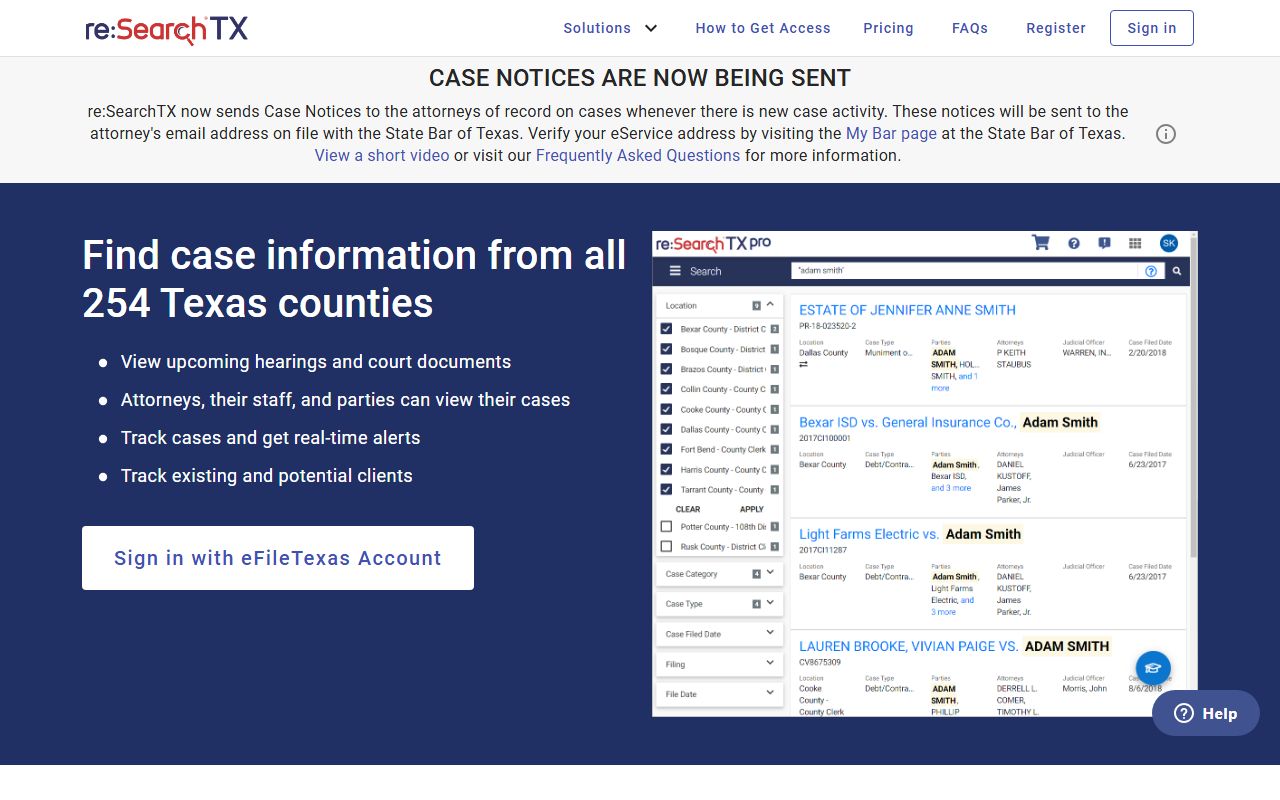
Statewide portals are useful starting points, but local clerk contact remains important for older files, certified copies, and records not visible to a public portal user.
Donley Court Search Fields
re:SearchTX field labels can change, and access can vary by court, record type, and user role. The research identified a limited public field inventory. When a court record after arrest does not appear, that may mean the case has not been filed, the court feed is limited, the spelling differs, access is restricted, or the record must be requested from the clerk.
| Field label | Type | Required | Notes |
|---|---|---|---|
| Search terms or party name | Text | Varies | Use defendant name when records are available. |
| Case number | Text | Optional path | Best when the clerk provides the exact case number. |
| Location or county | Filter | Optional | Select county or court if the portal exposes that filter. |
| Case type | Filter | Optional | Criminal, civil, family, or other categories may vary by court feed. |
| Search | Button | n/a | Runs the query. |
Donley Arrest Charging Documents
Charges become court records through written charging documents. The exact document depends on the offense level, prosecutor decision, court, and stage of the case. A complaint is a sworn allegation. An information is a prosecutor's charging instrument often used in misdemeanor and some felony contexts. An indictment is a grand-jury charging instrument. These documents can differ from the arrest charge listed at booking because prosecutors review evidence after the initial jail event.
| Document | Who uses or files it | What it does |
|---|---|---|
| Complaint | Officer, complainant, or prosecutor process depending on case type | States a sworn allegation and can support the start of a criminal matter. |
| Information | Prosecutor | States the formal charge without a grand-jury indictment where allowed. |
| Indictment | Grand jury | Charges a felony or other matter through grand-jury action. |
Donley Charge Status Records
Court records after a Donley County arrest should be read by status, not just by charge name. A pending charge is unresolved. An amended charge has changed. A reduced charge has moved to a lesser charge. A dismissed charge has been ended by court or prosecutor action. A disposition is the final case outcome, such as conviction, dismissal, acquittal, deferred adjudication, or another final result.
| Status | What it means | Why it matters |
|---|---|---|
| Pending | The case or charge is not final. | Do not treat it as a conviction. |
| Amended | The charge language or level changed. | Booking language may no longer match court language. |
| Reduced | The charge moved to a lower offense or level. | Sentencing and record meaning may change. |
| Dismissed | The charge was ended without conviction on that count. | Record-clearing questions may require Texas expunction or nondisclosure review. |
| Disposition | The final court outcome. | Use this field to distinguish accusation from outcome. |
Donley Court Record Offices
The County/District Clerk page lists Vicky Tunnell at Drawer U, Clarendon, TX 79226, phone (806) 874-3436, fax (806) 874-3351, and email doncoclerk@co.donley.tx.us. The published hours are Monday through Thursday 7:30am to noon and 1:00pm to 4:45pm, and Friday 7:30am to 1:00pm. Use those hours for clerk and court-record questions, not jail visitation, because no jail visitation hours were located.
Donley County/District Clerk
Drawer U
Clarendon, TX 79226
(806) 874-3436
Clerk records, docket questions, older files, and certified-copy routing.
100th Judicial District Court
100 Ave. E North West, Box 3
Childress, TX 79201
940-937-7070
District court administration for the 100th Judicial District.
Donley Prosecutor Roles
The County Attorney page lists Landon Lambert, P.O. Box 876, physical address 309 S. Sully, Clarendon, phone 806.874.0216, and a victim-assistance coordinator contact. The District Attorney page lists Luke M. Inman for the 100th Judicial District, 800 West Avenue, Box 1, Wellington, TX 79095, phone (806) 447-0055. Prosecutors review cases and file or handle charges, but they do not run the jail roster and should not be treated as a custody-status hotline.
The 100th Judicial District Attorney page is one official source for felony district-level prosecution contacts. Misdemeanor and local matters may involve the county attorney. Victim-notification questions can also involve VINELink when the relevant custody feed is available.
Bond After Donley Arrest
Texas Code of Criminal Procedure Article 17.15 sets broad bail factors. Bail should give reasonable assurance of appearance, should not be used as an instrument of oppression, and should consider the offense, ability to make bail, and safety of victims and the community. Donley County does not publish a local jail bond schedule, bond desk hours, online payment portal, or accepted payment methods. For a person in custody, call the sheriff first. For a filed case, check the clerk or court.
| Bond type | How it works | Donley County note |
|---|---|---|
| Cash bond | Full cash amount posted with the authorized office or court. | Payment office and hours were not published. |
| Surety bond | A licensed bail bond company guarantees appearance for a fee. | No county bond-company list was located. |
| Personal or PR bond | Release on promise and court conditions without full cash deposit. | Requires magistrate or court authorization. |
| No-bond hold | Release is not available on that hold. | May involve court orders, warrants, parole, federal, or immigration issues. |
Donley Arrest Warrant Records
No official Donley County active warrant list, sheriff warrant search, most-wanted page, or warrant app was located. Warrant questions should be routed to the sheriff, issuing court, JP office, clerk, or district court depending on the warrant type. The county contact directory lists JP Sarah Hatley and JP Pat White for traffic-ticket questions. For a bench warrant tied to a filed case, the clerk or issuing court may be the better starting point than a general web search.
A warrant can lead to booking at Donley County Jail, but the warrant record, jail record, and court record are separate. Do not assume that a person with a warrant is currently in custody. Call the issuing office, ask whether the warrant is active, ask whether bond is set, and consider legal counsel before surrendering or traveling to a jail.
Charges Versus Convictions
An arrest charge is an accusation at the start of the process. A conviction is an outcome after a guilty plea, verdict, or other court result that counts as a conviction under the record system being searched. Donley County court records after arrest may show charges that are later amended, reduced, dismissed, or resolved in another way. That is why disposition is the key field when judging what a court record means.
| Point of comparison | Charge | Conviction |
|---|---|---|
| Stage | Accusation or filed count | Final or qualifying court outcome |
| Proof level | Depends on arrest, complaint, filing, or indictment stage | Based on plea, verdict, or judgment |
| Can change | Yes, it may be amended, reduced, or dismissed | Can still be appealed, set aside, sealed, or expunged only under specific rules |
| Where to verify | Clerk, court docket, prosecutor filing | Clerk judgment record or DPS conviction history |
Sealed or Expunged Arrest Records
Texas record cleanup is not a simple website removal request. Texas Code of Criminal Procedure Chapter 55 governs expunction for qualifying arrests and records. Nondisclosure is a separate route that limits public access to certain criminal history. Eligibility depends on the charge, outcome, timing, prior record, and court order. A dismissed charge is not automatically removed from every record system without the proper legal process.
| Record action | What it does | Practical meaning |
|---|---|---|
| Nondisclosure | Limits public access to certain criminal history. | Some agencies may still retain lawful access. |
| Expunction | Removes or destroys qualifying records under court order. | Eligibility is specific and must be checked under Texas law. |
| Correction | Fixes an error in a record. | Start with the office that created the record. |
Restricted Donley Court Records
Not every record related to an arrest is public in full. Juvenile records, sealed records, expunged records, medical or mental-health information, victim details, some active-investigation material, and security-sensitive material can be restricted or redacted. Government Code Section 552.108 can protect certain law-enforcement records, while Section 552.108(c) preserves access to basic information about an arrested person, an arrest, or a crime. The practical result is mixed: some basic arrest information may be public, while the full file may not be released.
Important: Use court records after arrest for case status and disposition, not for employment, tenant, credit, insurance, or other FCRA-covered screening.
Public Record Search
Sponsored Results